Made It!

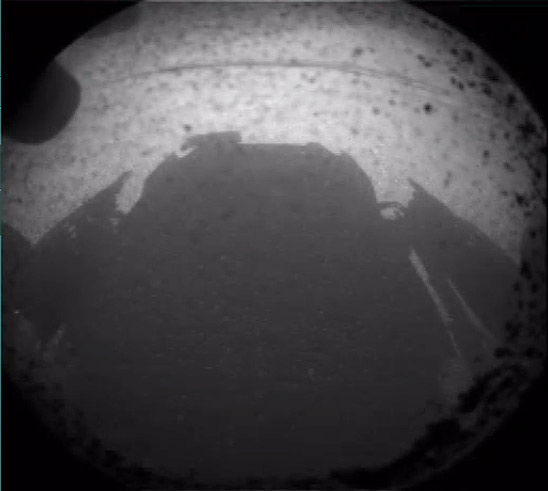
The Curiosity rover has landed on Mars, intact, on schedule, and is sending back images! 
I think this might be the moon landing of my generation. I mean, we accurately sent a robot through space for eight months, pretty much lowered it onto a different planet via a sky crane, and now we can see what it sees? My god. Good job, humans. Good job.
(Didn’t stay up to watch the landing? Check out the NASA JPL site for all the details. Curiosity’s Twitter stream is pretty cute, too.)

Friday Unrelated Information

1. I’ve always been someone who skips ahead in books and likes to know the plots of movies I’m going to see, so I thought this study was interesting:
Two researchers in the psychology department of the University of California at San Diego recently decided to test whether we really hate spoilers, or just like to say we do. What they found surprised them: The majority of people apparently like having a story spoiled for them. In fact, we may enjoy spoiled stories even more than the unspoiled versions.
2. The Mars Curiosity rover is scheduled to make its crazy complicated descent Sunday night at 11:30 MST. Here’s a good roundup of coverage of the landing. Come on, Curiosity!

Two Videos

Here is a video “trailer” for the Mars Curiosity rover landing on August 5, found via Bad Astronomy. It is worth the five minutes to watch it because in five minutes you can have your mind blown and your faith in humanity reaffirmed:
I usually dislike taglines but “Dare mighty things” at the end kind of made me tear up a little.
And here is a video created by the European Commission as part of the “Science: It’s a Girl Thing!” campaign to encourage girls to study science (it’s now been pulled from the campaign).  This also blows the mind and brings you close to tears–but not in a good way:
To quote Elwood Blues, “Jesus H. Tap Dancing Christ.” To quote the article in The Atlantic where I found this, “…science sells itself. It needs no polish or varnish or manufactured appeal to be attractive to women. To imply otherwise is an insult. To science and to women.”

Two Things To Make You Happy Today

1. Space always does the trick for me. I’m sure you’ve heard by now that Voyager 1, launched in 1977 with the famous golden record of Earth sounds, is nearing the very edge of our solar system. I think the Daily Mail put this fact in context really well:

With absolutely no attempt at hyperbole at all, it is fair to say that this is one of–if not the–biggest achievement of the human race. For, as we speak, an object conceived in the human mind, and built by our tools, and launched from our planet, is sailing out of the further depths of our solar system–and will be the first object made by man to sail out into interstellar space.”

2. And in further news of humans living up to the name, here’s something that’s been making the rounds: 21 Pictures That Will Restore Your Faith In Humanity. I just had to think of the end of the second Lord of the Rings movie and Sam saying, “There’s still some good in this world, Mr. Frodo.”

Friday Unrelated Information

1. It’s a long weekend, hooray!
2. Have you been following the launch of the Dragon capsule from SpaceX? Something American-made is back in space, and it’s been successfully captured by the ISS! I’ve been getting my news from Bad Astronomy
3. From the creator of last week’s hit, “Lazy Harp Seal,” I give you “Cat Licking a Hamster.”

Colonies in space!

Worthy Of Dr. Sagan


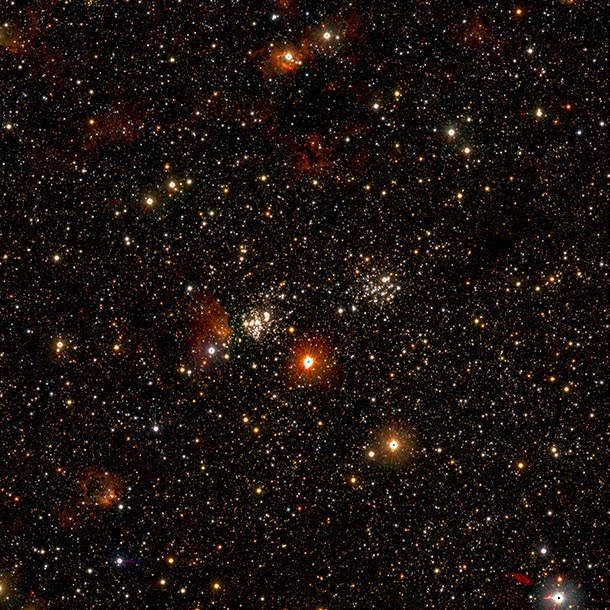
You guys. Phil Plait at the Bad Astronomy blog has outdone himself. He’s describing a massive, massive infrared survey of the sky–over 150 billion pixels, showing a billion stars–and he does it really, really well (click through to see how he gives an idea of scale). But it’s at the end of the post that he gets really Sagan-esque:

Think on this: there are a billion stars in that image alone, but that’s less than 1% of the total number of stars in our galaxy! As deep and broad as this amazing picture is, it’s a tiny slice of our local Universe.

And once again, we’ve reached the point where I’m out of words. Our puny brains, evolved to count the number of our fingers and toes, to grasp only what’s within reach, to picture only what we can immediately see — balk at these images.

But… we took them. Human beings looked up and wondered, looked around and observed, looked out and discovered. In our quest to seek ever more knowledge, we built the tools needed to make these pictures: the telescopes, the detectors, the computers. And all along, the power behind that magnificent work was our squishy pink brains.

A billion stars in one shot, thanks to a fleshy mass of collected neurons weighing a kilogram or so. The Universe is amazing, but so are we.
Space News

Another new supernova has been found as of March 16. This one in barred spiral galaxy M95, which is roughly the size of our own Milky Way galaxy and about 37 million light years away. Supernova SN 2012aw is the really bright point at the end of the spiral arm that goes down and to the right–see it?
Oh, space. You provide such good perspective.

(Picture from APOD; you can read more about the supernova on Bad Astronomy.)