Wednesday Essay: “How To Stay Hopeful”

Here’s an essay from last summer from designer and writer Mike Monteiro this week, which popped into my head because of that terrifying Ring Superbowl ad. The whole thing is heartening, but the ending here is the pull quote I saved:

Our current dystopia is built on fear. Fear of our neighbors. Fear of our communities. Fear of others. Fear that they will eventually come for you, so why not offer them someone else in your place. It’s easy to fall for this and let dystopia wash over you. You literally have to do nothing. You can sit there, thinking that it’s all too big to fix, because it is very very big. And it is very very bad.

Dystopia is easy. You take what people are afraid of and tell them it’s right outside their door. The cure is to open the door and see the truth for yourself. What’s on the other side of the door is your neighbors, and some of them brought donuts.

There is hope. As long as you are here, and I am here, and we are here there is hope. It may not be a lot, but with every hopeful step you take there’s a little more.

Thursday Essay (And Music)

This piece by Adam Serwer in The Atlantic is worth your time today. He rides along with a few volunteers–some delivering food, some watching ICE–and, in a very dry Atlantic way, absolutely destroys the assholes responsible for this occupation.

For example:

[The] remarks reminded me of something Stephen Miller, the Trump adviser, had written: “Migrants and their descendants recreate the conditions, and terrors, of their broken homelands.” In Minnesota, the opposite was happening. The “conditions and terrors” of immigrants’ “broken homelands” weren’t being re-created by immigrants. They were being re-created by people like Miller. The immigrants simply have the experience to recognize them.


and:

The federal surge into Minneapolis reflects a series of mistaken MAGA assumptions. The first is the belief that diverse communities aren’t possible: “Social bonds form among people who have something in common,” Vance said in a speech last July. “If you stop importing millions of foreigners into the country, you allow social cohesion to form naturally.” Vance’s remarks are the antithesis to the neighborism of the Twin Cities, whose people do not share the narcissism of being capable of loving only those who are exactly like them.


But the quote from this piece that I see going around the most is near the end, and it’s circulating for good reason:

The secret fear of the morally depraved is that virtue is actually common, and that they’re the ones who are alone. In Minnesota, all of the ideological cornerstones of MAGA have been proved false at once. Minnesotans, not the armed thugs of ICE and the Border Patrol, are brave. Minnesotans have shown that their community is socially cohesive—because of its diversity and not in spite of it. Minnesotans have found and loved one another in a world atomized by social media, where empty men have tried to fill their lonely soul with lies about their own inherent superiority. Minnesotans have preserved everything worthwhile about “Western civilization,” while armed brutes try to tear it down by force.


And if that didn’t get you fired up enough, listen to this song Bruce Springsteen wrote Saturday, recorded Sunday, mixed Monday, and dropped Tuesday. Solidarity!

Something To Consider

After how hard 2025 was, I don’t want to come out and say, “Let’s have more friction in 2026!” But I’ve read two different essays in the last two days about purposely adding friction back in to everyday life via turning your phone off, quitting delivery services, getting out of the car and back on foot, etc.

Dan Sheehan puts it like this, defining what he calls “The Smooth World” (emphasis mine):

The Smooth World, as it is currently and continually designed, is meant to avoid friction at all cost. In it, food can be delivered to your doorstep by unseen butlers, cars turn every excursion out of the house into an isolating door-to-door commute, and in whatever small ways you’re forced to interact with others, you now all have the option of doing so while simultaneously anesthetizing yourself with an unending stream of short form video content.

But hey, those things are chores! Surely optimizing them out of our lives has left more room for leisure! But the optimization hasn’t stopped at chores. Where once games, entertainment, and hobbies were a way of blowing off steam, now many opt instead to remain submerged in that unending stream of content. Our attention is no longer ours to give, having become a new frontier for those who wish to sell targeted advertising.


And Kathryn Jezer-Morton writes,

Tech companies are succeeding in making us think of life itself as inconvenient and something to be continuously escaping from, into digital padded rooms of predictive algorithms and single-tap commands: Reading is boring; talking is awkward; moving is tiring; leaving the house is daunting. Thinking is hard. Interacting with strangers is scary. Risking an unexpected reaction from someone isn’t worth it. Speaking at all — overrated. These are all frictions that we can now eliminate, easily, and we do.


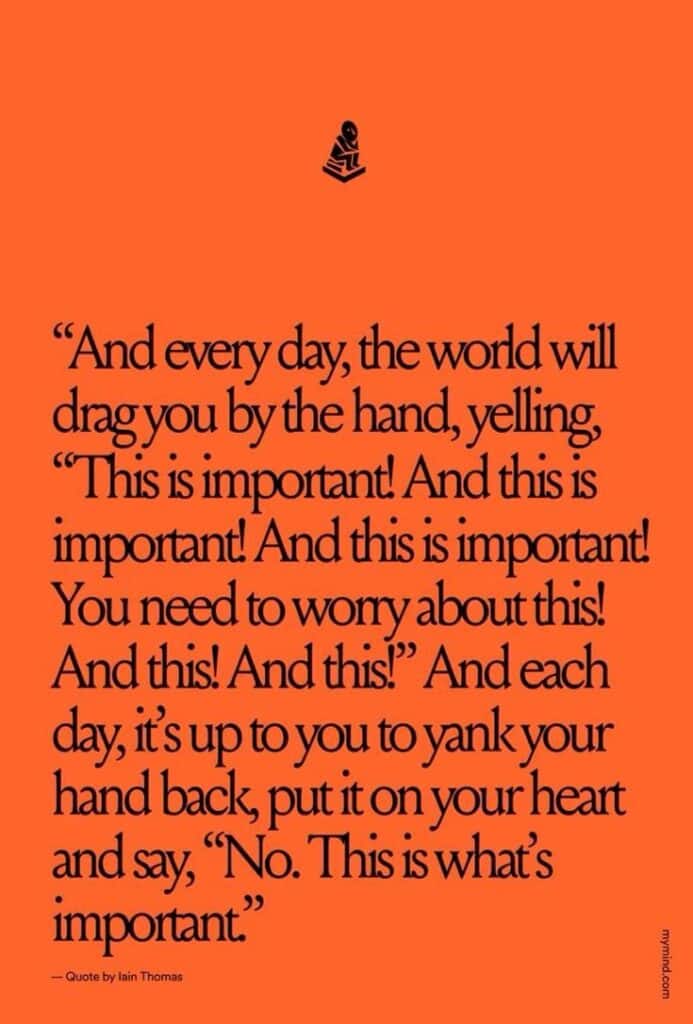
Maybe it’s more about remembering where our attention is going than wanting more friction (because even though I see their points, I am not about to say out loud, “Let’s have a difficult year!”). Black text on an orange background that says, "And every day, the world will drag you by the hand, yelling,
"This is important! And this is important! And this is important!
You need to worry about this!
And this! And this!." And each day, it's up to you to yank your hand back, put it on your heart and say, "No. This is what's important"


Birthday Vibes From Essays

I’m turning 46 tomorrow (!) and still processing the last year and what I want this one to look like, so I’m not sure I have a clear birthday “word for the year” yet. But I think it might be the ideas found in these two unrelated articles.

The first is a dense essay about how the idea of entropy should change our philosophy–“what would our metaphysics and ethics look like if we learned that reality was against us?” The author spends a lot of time getting there, but his idea of “goodness” in a decaying universe was really striking: 


“Goodness could consist in any act that seeks, however briefly, to bend the entropic thrust of existence back upon itself – holding it at bay, even if only momentarily. We glimpse this resistance in acts of compassionate care for the suffering, and in efforts to minimise the harm we inflict on the world around us.” 


Echoing that idea, the second essay is actually a short post from author Max Gladstone, an allegory about a cast-iron pan he had to restore. He ends it thusly:

One thing we can do against that moment when “all that is solid melts into air,” is to not let it. Fix the thing that seems broken. Form and build the bonds that seem so fragile and so easily torn away. Maybe you can’t walk forever into the wind of change—but each step does matter, and if you can’t imagine even taking a step, at least you can try. […] The Buddha’s right, I think, that all things are transient and empty of inherent fixed being and that the root of suffering can be found in clinging to impermanent things as if they were permanent, but when he says all he really means it, he’s talking about us. You, me, the cast iron pan, the world, we’re all in this together. If the perfect state is impermanent, unfixed—that must apply to the broken state as well. The mess is a gateway to the work, the practice, and at the end of the day, the practice is what we have.


“The mess is a gateway to the work” hit me as hard as “luxurious complications.” Maybe that’s my phrase for 46.

Luxurious Complications

Austin Kleon interviewed artist Sally Mann and her answer to, “Describe a perfect day,” was spot on:

Every day is a perfect day. I am the luckiest person alive. The unmeasurable, incalculable complications of family and property and animals and career are all luxurious complications: I am lucky to have them and they enrich my life, even as they cause me to grind my molars into shards.

I’m going to remember that phrase the next time I start stressing about remodeling or using the PET PRO URINE REMOVER carpet cleaner. “Luxurious complications” instead!


(Bonus, she lifts!  “Now, at age 74, three days a week I lift weights (I mean, heavy weights) and do planks until my whole body is shaking, and weighted squats, lunges, crunches. Two days a week I row, between 8 and 12K, ie between 40-50 mins, and the two remaining days I run 3 miles on a hilly trail on the farm. I hate every minute of it. I never miss a day.”)

Ode To The Em Dash

For the last few months, work has been going deep into AI “tools” and my fellow writers have talked about how readers think something was generated by an LLM if it contains em dashes. So imagine my delight at this takedown of that idea, absolutely riddled with em dashes in a beautiful way: Stop AI-Shaming Our Precious, Kindly Em Dashes—Please

“The idea—the terrible, mistaken idea—is that the use of em dashes in a piece of writing is a sign that the text was generated by AI. Some people have been saying this on, guess where, the internet. The implication is that human writers should avoid em dashes for fear of being mistaken for chatbots. No. Wrong. I am here to raze this implication to the very ground and salt the earth where it stood.”

As the author notes,

“If generative AI does have a predilection for em dashes, though, the reason is simply that many human writers use em dashes. Your chatbot also uses commas, just as human writers do. A chatbot does not have a consciousness. It does not “know” how to write, in any meaningful sense. It doesn’t have a style, because style requires thought, preference, and taste. A gen-AI chatbot is trained by scanning gargantuan amounts of text. Based on the patterns it detects in that text, it then assesses the probability that certain words and syntactic constructions will occur in proximity to one another.

[… ] In other words, it’s not accurate to say that the use of em dashes in a text is a sign that the text is AI-generated. It’s more accurate to say that the prevalence of em dashes in AI-generated text is a sign of how reliant the AI companies are on the human writers they want to replace.”


Long Read: The AI Bubble

Did you want 14,000 words about why the AI industry sucks (beyond the environmental harms or the real risks to vulnerable individuals, that is)? I give you Ed Zitron’s “The Hater’s Guide to the AI Bubble.”

This is my very abbreviated summary, but in the Hater’s Guide he explains that 1) companies pushing AI aren’t making real money from it (or are actually losing money); in part because 2) essentially there is no breakout or standalone AI software or service; and 3) the whole “AI industry” is actually just based on buying and selling GPUs:

Microsoft, Meta, Google, Apple, Amazon and Tesla aren’t making much money from AI — in fact, they’re losing billions of dollars on whatever revenues they do make from it. Their stock growth is not coming from actual revenue, but the vibes around “being an AI company,” which means absolutely jack shit when you don’t have the users, finances, or products to back them up.

So, really, everything comes down to NVIDIA’s ability to sell GPUs, and this industry, if we’re really honest, at this point only exists to do so. Generative AI products do not provide significant revenue growth, its products are not useful in the way that unlocks significant business value, and the products that have some adoption run at such a grotesque loss.

And that’s where we get the bubble, which…seems bad! (This unrelated quick explanation on adjusted job numbers from the Bureau of Labor Statistics included this fun nugget: “Capex spending for AI contributed more to growth in the U.S. economy in the past two quarters than all of consumer spending, says Neil Dutta, head of economic research at Renaissance Macro Research, citing data from the Bureau of Economic Analysis.”)

Zitron’s conclusion in his hater’s guide articulates so much of what I also dislike about AI:

There is an overwhelming condescension that comes from fans of generative AI — the sense that they know something you don’t, something they double down on. We are being forced to use it by bosses, or services we like that now insist it’s part of our documents or our search engines, not because it does something, but because those pushing it need us to use it to prove that they know what’s going on.

… generative AI also brings out the worst in some people. By giving the illusion of labor, it excites those who are desperate to replace or commoditize it. By giving the illusion of education, it excites those who are too idle to actually learn things by convincing them that in a few minutes they can learn quantum physics. By giving the illusion of activity, it allows the gluttony of Business Idiots that control everything to pretend that they do something. By giving the illusion of futurity, it gives reporters that have long-since disconnected from actual software and hardware the ability to pretend that they know what’s happening in the tech industry.

And, fundamentally, its biggest illusion is economic activity, because despite being questionably-useful and burning billions of dollars, its need to do so creates a justification for spending billions of dollars on GPUs and data center sprawl, which allows big tech to sink money into something and give the illusion of growth.

Uncertainty Training

I don’t remember how I ended up on Jocelyn K. Glei’s mailing list but I’ve been getting her emails for years now. I skim a lot of it but last week’s subject line caught my attention: “Uncertainty training.

Of course, my first thought (“Yes! Tell me what to do to make the uncertainty stop!”) was not exactly the point of the email, but I do think it’s a helpful re-frame regardless:

One metaphor that I’ve been working with lately to cultivate a more friendly attitude toward the current state of chaos and disruption is the idea of “uncertainty training.”

Depending on our level of privilege, each of us have had very different experiences of “uncertainty” in this life so far. But now, given the precarious state of our planet, our climate, and our democracy, we all seem to have been collectively enrolled in a new kind of “uncertainty training.”

… On a walk through the woods the other day, I was interrogating this idea of “uncertainty training” — what does that phrase even mean? And what, exactly, would uncertainty training look like?

I suppose the appeal of the “training” reframe is that it creates the feeling of a useful learning program that you are opting into with some long-term benefit in mind. That it’s not just that everything is falling apart and you’re holding it together as best you can, but that there’s some kind of method to the madness, some greater purpose to everything that’s unfolding.

I think the greater purpose is just learning to be human, or how to enjoy life despite the horrors. As she continues:

Going on my morning walk everyday, making a cup of tea, taking time to breathe and come back into my heart, writing in my journal, talking it out with a friend. Assembling tiny little anchor points minute-by-minute, day-by-day, to keep myself grounded and sane.

And maybe, in the end, that’s all that we are training for. To attune more deeply to the medicines we have to offer each other and ourselves, to the practices that help us stay rooted, to our own capacity to breathe in, to breathe out, and to hold more.

How To Write Insults

Hamilton Nolan’s newsletter this week is a masterclass in insults. Of course, it’s easy when the target is ICE “I’d rather destroy the lives of entire families than have the fellas make fun of me” agents, aka “twitchy, puffed up, goofy ass cops.”

Please, enjoy:

It can be difficult to laugh at riot cops. But we should all try. Because they’re so fucking ridiculous. Hey, nice huge helmet and body armor and fake ass gun and shield to oppose a bunch of skater kids waving around flags. You all are the most terrified group of human beings in the United States of America. You all are the types of people who open carry handguns to go to Buffalo Wild Wings. You all need to stop getting your news from idiots on idiot websites. You all need to read some fucking books and gain a minimal sense of perspective. You all need to embrace the crushing realization that for your whole lives you have been afraid and confused and have embraced a misguided set of macho enticements that have seduced you into believing that manhood depends on looking like some sort of cartoon action figure when in fact it is this look that reveals to the world the deep inadequacy that haunts you every day.


As he concludes, “Fuck off, losers.”


Wednesday Essay

This is from Mike Monteiro, a designer and writer and just all around smart guy. He’s been answering questions and this is in answer to, “How can we stay positive about the future these days?” His replies often have a lot of personal anecdote but they always work out as a metaphor–especially here.

… we couldn’t afford to heat the entire house. So during the winter, we heated what we could. And during those winter months, if you needed heat, you came to the living room …

Sometimes you cannot heat the whole house. The heat rises, it spirals. It escapes through every crack.

Sometimes you cannot be positive about the future.
But what if we redefined what we had to heat? What if we redefined the future to something we could actually manage. Because the future is too vague a term, and filled with too much uncertainty.

What if we could be positive about tomorrow?

[…] Spiraling into hopelessness helps no one. Giving an unhoused person $20 and a winter jacket that’s been sitting in the back of your closet might only help one person, but it also helps one person. When the systemic issues feel too big, we do what we can. When we cannot heat the whole house, we heat the core.