Say It Louder

Journalist Lyz Lenz wrote a column yesterday about why exactly women are so angry about that video of the Olympic men’s hockey team laughing along with Dear Leader about inviting the women’s team too: Because these men undoubtedly think they support women, but no one spoke up. No one walked away. No one said, “The women’s team did great, though.” No one!

As she says, “…it’s not enough not to say harmful things about people; you have to speak up when other people are. You have to walk away. Because if people are saying those things and you stay silent, it’s just as bad or worse. You are letting bad things happen while thinking you are good.”

Lord knows I speak up about it now, and men don’t take it well (I remember a boss in 2022 mocking the intelligence of a woman who wasn’t on the call and how he ended up berating me for 10 minutes after I tried to defend her). But when another man calls it out, suddenly that assumption that this language, this behavior, is OK gets challenged.

Something to think about, men!

If It’s A Socialist Holiday, Count Me In

I’d never given much thought to International Women’s Day, assuming it was a corporate ploy to pay lip service to women while doing everything they can to maintain the status quo. (In fact, that is exactly what internationalwomensday.com is, full of fluff about changing the world with…poses?)

But I just started following feminist Clementine Ford and learned from her posts and stories that IWD was started by Theresa Malkiel, a factory worker and first woman leader in the Socialist party. Per Wikipedia,

In theory, the Socialist party was committed to equal rights for men and women, but in practice, it made no effort to reach out specifically to women workers and showed little interest in their concerns. Malkiel concluded that socialist women would have to fight their own parallel battle for equality.

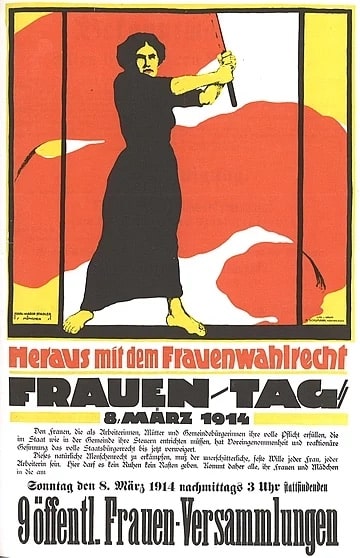
Thus, National Women’s Day in NYC in 1909; in 1910, the International Socialist Women’s Conference proposed a Women’s Day promoting equal rights and suffrage, and it was celebrated officially in 1911.

It remained a Socialist/working class event until 1967, when second-wave feminism jumped on board and it got more widespread attention. In 1975, the UN recognized the holiday…and here we are. Again, per Wikipedia:

By the twenty-first century, IWD has been criticized as heavily diluted and commercialized, particularly in the West, where it is sponsored by major corporations and used to promote general and vague notions of equality, rather than radical social reforms

I dunno, comrades…given that American women can’t get an abortion in 21 states, trans women are afraid for their lives, the gender pay gap keeps getting worse, especially for women of color, and the American right seems to want to take us straight into The Handmaid’s Tale... it might be time to get a little radical again.

Misogyny, Mentoring

Anne Helen Petersen’s latest newsletter was a free-form list of things that are part of “The Subtle Look and Overwhelming Feel of Today’s Misogyny.” Number 7 (“I survived it, you can too”) got me–I don’t think this way but I loved her take on mentoring (emphasis mine):

This sort of rhetoric — particularly when it comes from more senior women in regard to office behaviors, amounts of maternity leave, attitudes towards toxic work environments, and work flexibility — is Lean In status-quo reinforcing bullshit. To mentor does not mean showing another woman how to navigate your path. It’s highlighting what was broken about the path you had to navigate, and then using your accumulated power to try and make sure that others don’t have to replicate the suffering.


Now I just need to get another woman on my team to actually mentor…

Dads, Helplessness, DIY

In the middle of the bathroom remodel, Lyz Lenz sent out a newsletter about learning how to do house maintenance on her own, after a conservative Christian upbringing that kept her pretty helpless:

My helplessness is not an accident. It’s who I was raised to be. A woman who could cook and clean, but not swing a hammer. That kind of bat your eyes, “Aw honey, can you fix this thing?” kind of woman. The Joanna to the Chip Gaines. The wife who does the design and the painting. The man who wields the power tools.

I’m not saying my dad ever kept knowledge from me–the opposite, in fact. Growing up, he’d take me to Home Depot and the fancy hardwood store. I’d hang out in his shop while he worked. We’d watch New Yankee Workshop and The Woodwright’s Shop and This Old House together on Saturdays. But I saw my mom making the plans for projects and letting him execute them, and it was easy to follow that model. Instead of wanting to learn how to do it, I’d come to my dad with an idea and say, “Do this for me”–and then I’d just enjoy a finished product.

I don’t know what exactly changed in the last few years to make me want to learn to do things for myself, except that life-changing trifecta of Meds/Therapy/Gym. Honestly, I think that last one was what really pushed me into learning home stuff–I can finally carry boxes of tile up the stairs, and muscle grout into joints, and actually hold things up and not make my dad do all the (literal) heavy lifting. Embracing all my beginner lifts also showed me there’s no shame in being bad at something or admitting “I’m not good at this.”

It was also important to me to learn from my dad–“while I still can” sounds kind of morbid, but after losing my mom, things just feel a little more immediate. My mom taught me so much about sewing and cooking, but there are still a few things I wish I’d asked her. I didn’t want that to happen with my dad, who has a lifetime of craftsmanship to share.

In her newsletter, Lyz ends up learning from YouTube videos:

Am I really doing it alone if I have these YouTube dads genially explaining to me what a clamp is? It’s a vision of a masculinity I’ve never experienced before. No one is screaming. No one is disappointed in me. Wanting more of me. Telling me I can’t do it. It’s just gentle instruction and the pleasure of fixing something.

Again, my experience growing up wasn’t like hers–I’m lucky enough to have a dad who believes in me. So I want to publicly thank him for  going along with my plan to learn from him, for never saying I couldn’t do anything, for being the “gentle instruction” of the YouTube dads but also being my very own dad.
Every Single Word of This

On the heels of a man murdering 8 people–6 of them Asian American women–to eliminate his “temptation” for a “sexual addiction,” can we stop and read this?

There’s more to the Atlanta shooting than misogyny–there’s racism, the fetishization of Asian women, a growing wave of hate crimes, but I just need to say: Women are not the problem. Asian Americans are not the problem. The problem is white male domestic terrorists, and I hope we can treat this guy as such.


Thursday Reading

I’ve been sitting on this article for a few weeks now, but it seems like a good time to post about “The Myth of the Male Bumbler“–as more and more violent insurrectionists are arrested, how many of them will say they just got carried away in the spur of the moment? They didn’t realize what other people had planned? Gosh!

As Lili Loofbourow writes in The Week,

“Incompetence is less damaging than malice. And men—particularly powerful men—use that loophole like corporations use off-shore accounts. The bumbler takes one of our culture’s most muscular myths—that men are clueless—and weaponizes it into an alibi.”

It’s a great piece (if you want your blood to boil) and after you read it, you’re going to see that alibi of incompetence everywhere.

100 Years

Today is the hundredth anniversary of the ratification of the 19th Amendment, guaranteeing white women the right to vote. That seems like an alarmingly short time; at the same time, all women weren’t guaranteed the right for another 50 years:

Among those necessary laws were the repeal of the Chinese Exclusion Act in 1943 and the adoption of the Immigration and Nationality Act of 1952, the 24th Amendment in 1964 and the Voting Rights Act in 1965, along with its amendments of 1970 and 1975.

As that Times editorial goes on to say, “In other words, the 19th Amendment was one step in a long, racially fraught battle for voting rights that seemed secure a few decades ago but face a grave threat today.”

Every time I vote, I think, “People have literally been beaten and arrested so I can do this.” Don’t let anyone take it away. Get your ballots in early.


Let’s Get Political Again

Mom’s illness pushed a lot of the shitshow that politics continue to be out of my head, but let’s get our blood boiling again! “Joe Biden Isn’t the Answer” is a long and damning piece by Rebecca Traister about Joe’s appeal to white guys, his policies, and the creepy af way he touches women.

The gross physical familiarity and disrespect radiated toward [Lucy Flores] by a man in her field, in a public space, treating her body as if it was his to smell and squeeze and kiss, is classically, casually—even while non-cataclysmically—symptomatic of the daily, easy belief that men can treat women’s bodies as accessible, without regard to the comfort or desires of the women in question. It is also further evidence that Anita Hill’s testimony—grounded as it was in the notion that unwanted, inappropriate verbal and physical contact is unacceptable in a professional context—left no impression on him. Here’s the truth: If Joe Biden had ever done two minutes of actual thinking about the harm he’d helped to inflict on Hill, on women, and on the nation in handling of those hearings, he wouldn’t still be doing this kind of thing.


(For anyone who would argue that Joe’s behavior “isn’t as bad” as our current President’s, may I put forth this radical idea: What if we elected someone with NO history of touching people inappropriately? They are out there! They exist!)

Pixar For The Point

Kottke posted about this Pixar SparkShort this week and, as a 13-year industry “veteran” who still has teams who are mostly men, it really hit me. As Kottke writes, “The story was inspired by Lester’s experience working in animation as the only woman at her company.”

In order to do the thing that I loved, I sort of became one of the guys. And then I came to Pixar and I started to work on teams with women for the first time. And that actually made me realize how much of the female aspect of myself I had buried and left behind.

Yes, it’s a fun eight-minute Pixar short and no, I don’t ACTUALLY think of myself as a pink ball of yarn, but Pixar knows how to make a potentially heavy-handed metaphor work.